| Welcome to the home page of www.nuclearfusion.be |
 |
| This site contains exclusive information about a new type of Fusion reactor which exist only on paper, so far. Some theory and calculations of the concept is based on known theory from other fusion research. Some information is only assumed, because no practical data is available yet. Its only a proposal of a very interesting idea. The Theory's still have to be reviewed by other people and practical research still have to be done. This knowledge is shared to convince an organization, institute or company to put the idea into practice. In theory most of the problems known in Tokamak and other fusion reactors seemed to be solved. The idea is patented and approved to be unique. Read further and convince yourself. technical dicusions can be done on the Facebook page.
Click here to go to the patent about the reactor: https://patents.google.com/patent/BE1019002A3/en Click here to go to the facebook page about the reactor: https://www.facebook.com/nuclearfusion |
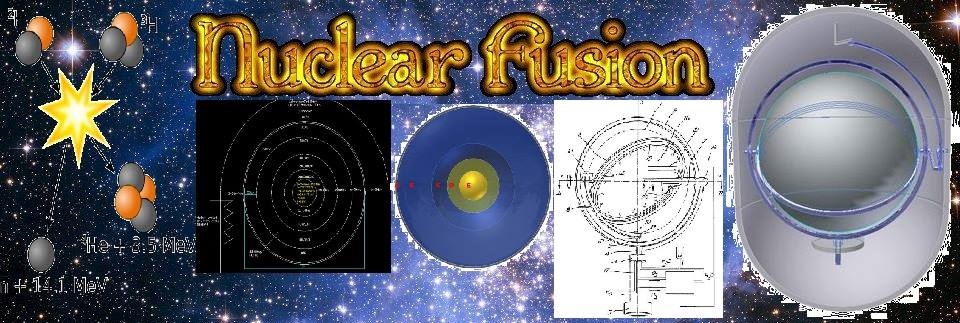
| This new approach for nuclear fusion consist of a plasma which is isolated from the environment with centrifugal forces. A dual rotating field must suppress heat convection. The plasma is static compressed to several hundred's of bar's resulting in ion densities much higher than MCF (magnetic confined fusion) (10^15-10^16 ions per cm³). The hot fusion plasma is surrounded by non fusing, colder, denser plasma. Only light elements confine the plasma, these moderate neutrons and don't generate much bremsstrahlung radiation. Due to the centrifugal forces the hottest lightest plasma is kept in the center. Magnetic fields can rotate the plasma faster so that heat convection is better suppressed. The plasma is heated with induction fields and microwaves to a minimum temperature of 10 kev, 150 million degrees. An increase in pressure can augment the fusion temperature. After fusion is initiated the pressure can be kept constant and the plasma remains hot due to its own produced fusion energy. New fuel ions are accelerated and injected into the core of the fusion reactor. With this concept you are able to bring the plasma at high pressure. In magnetic confined schemes it is necessary to do it in vacuum, otherwise you would have heat convection. Archimedes forces pulling the plasma against the roof of the plasma container. If you have high ion pressure only a small volume of working plasma is required. When we look at the reaction deuterium plus tritium, it generates a neutron of 14,1 Mev. These are very energetic neutrons, compare to neutrons from a fission chain, they are only 2 Mev. These extremely fast neutrons or also extreme in quantities. For every 17,6 Mev of fusion energy there is one neutron, for every 200 Mev of fission energy there is 2,5 neutrons. So you would have nearly 5 times more neutrons. 80% of the produced fusion energy is in the form of neutrons. For fission its only 5%. If you look at magnetic confined schemes the plasma is very low in density and is surrounded by vacuum. So there isn't anything that moderating the neutrons. The scattering neutron collisions causes the reactor material to ionize. The ions are then pushed into the plasma by the magnetic fields. More bremstralung radiation will be generated if heavy elements are present in the plasma. When we look at this concept, the neutron flux will be many times higher because the fusion rate per volume plasma is much higher. The high pressure will raise the amount of particles per volume and the plasma will absorb much more neutron energy. The working deuterium tritium plasma is surrounded by ionized helium-hydrogen mixture. These ions also moderating the neutrons and will heat up. The plasma will be more likely to be self-sustaining and don't have the problem of heavy particle poisoning occurring in magnetic confined plasma's. So unlike a Tokamak, It can run steady-state, the plasma don't have to be replaced every hour (or every 10 minutes), it could run for years. On the picture below, right, zone E is the working fusion plasma that consist mostly of deuterium en tritium which are fused to helium. A constant stream of new fuel ions must be injected to keep the plasma burning. The injection system, a plasma, particle accelerator will be discussed later. Charged particles can be injected since there are no magnetic fields. To reach the high temperature in the beginning a heating system must be used. Microwaves, RF heating with a gyrotron and induction fields could be used. As soon as the fusion temperature is reached, the plasma remains hot by its own produced fusion energy. The produced helium ions gives of their energy and cool down, they get heavier. The zone D is the plasma zone where no fusion reactions occur and consist mostly out of helium. Zone B is the layer of water or heavy water and contains a large amount of lithium hydroxide. This layer of water must moderate and absorb the neutrons. The neutrons must be absorbed by the lithium, so tritium is formed. alternatively, the neutrons can be cought in a surounding lithium bed. The use of a Li6-Li7 mixture, reduses the need for a neutron multiplier like berilium and wil reduce the operating kosts. The heat and neutron energy causing the water molecules to split up in elementary atoms. The splitting of water is endothermic using 572 KJ/mol and occur at more then 2000°C. This way a thermal barrier is created. Zone C consists of the formed hydrogen, oxygen and helium. The centrifugal forces must separated the gasses, so there can be an extraction that consist mostly of hydrogen and an extraction consist mostly of oxygen. As the gasses are extracted they are immediately cooled by injected water, reducing the volume of the gasses. The energy is extracted chemically instead of thermal. The advantages is that the energy converging efficiency is very high. Or the hydrogen can be used directly as fuel. The cold water that is injected got the highest density and will form the outer layer, protecting the vessel from high temperatures. The pressure must be higher than the supercritical water pressure, at least 220 bar. higher pressure resulting in higher fusion rates and better moderating coefficients. The higher the pressure, the shorter the required confinement time will be to reach ignition and the higher the power density of the reactor will be. The vessel is several meters across and generating gigawatts of power. The calculations show us that 350 liter plasma of 40 kev, 250 bar generates 3 Gigawatt. Its a theoretical calculation, the temperature will be variable and the gas-mixture won't be 50% deuterium tritium. But it gives a general idea. To generate 3GW In a Tokamak, it require several thousand cubic's of plasma.
|
| Tim Lardenoit (tim.lardenoit@nuclearfusion.be) ©2009-2021 www.nuclearfusion.be |